

Recognised as a UNESCO World Heritage Site in 1983, Ellora is much more than a collection of historical caves. It is a remarkable reflection of India’s artistic traditions, religious philosophies, architectural knowledge and cultural history. Whether you are planning your first visit to Maharashtra, travelling from another part of India or exploring the country as an international visitor, this guide to visiting the Ellora Caves will help you understand the destination, plan your visit and make the most of your time.
Where Are Ellora Caves Located?
Ellora Caves are situated near Verul village in Chhatrapati Sambhajinagar district of Maharashtra, approximately 30 kilometres from Chhatrapati Sambhajinagar city, formerly known as Aurangabad.
The caves are excavated into the Charanandri Hills, forming a spectacular stretch of rock-cut monuments extending over two kilometres.
The nearest major city is Chhatrapati Sambhajinagar, which is well connected to other Indian cities by road, railway and air.
Many travellers use the city as their base for exploring the region’s historical attractions, including Ajanta Caves, Daulatabad Fort, Grishneshwar Jyotirlinga Temple, Bibi Ka Maqbara and several lesser-known heritage sites.
If you are planning a Maharashtra heritage holiday, Ellora is one of the destinations you should not miss.
Why Are Ellora Caves So Famous?
The Ellora Caves are famous for their extraordinary rock-cut architecture and the presence of Buddhist, Hindu and Jain monuments within a single complex. There are 34 principal caves, created over several centuries, representing different religious traditions and architectural styles.
What makes Ellora particularly fascinating is that these monuments were not constructed using separately assembled stones. Instead, artisans carved directly into the natural basalt rock, removing enormous quantities of stone to create halls, pillars, sculptures, shrines and temples.
The complex demonstrates the remarkable technical knowledge, artistic imagination and craftsmanship of ancient Indian communities. Ellora also represents an important historical example of different religious traditions developing their monumental architecture within the same landscape.
The UNESCO World Heritage designation recognises its outstanding artistic achievement, historical importance and cultural significance.
History of Ellora Caves: Who Built Them and When?
The history of Ellora stretches across several centuries, reflecting the development of religious and artistic traditions in the Deccan region.
The earliest Buddhist caves are generally associated with the period beginning around the 5th and 6th centuries CE. Hindu monuments developed particularly during the subsequent centuries, while the Jain caves represent a later phase of activity.
The archaeological complex reflects patronage from different rulers, religious communities, merchants and other donors.
The Rashtrakuta dynasty played an especially important role in the development of the magnificent Kailasa Temple.
However, Ellora was not created by one king, one dynasty or one group of artisans. It was the result of generations of craftsmanship and religious patronage.
This is one of the reasons why exploring Ellora is so interesting. Every group of caves has its own architectural language, artistic details and religious significance.
Understanding the 34 Caves at Ellora
The 34 caves are traditionally divided into three main groups.
Buddhist Caves (Caves 1–12)
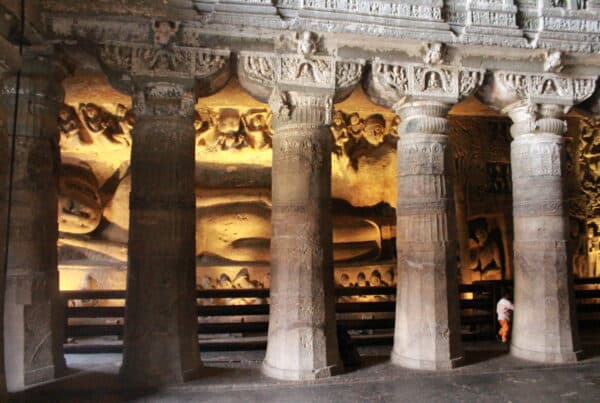
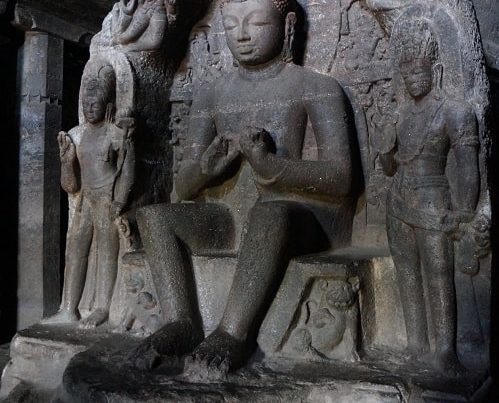
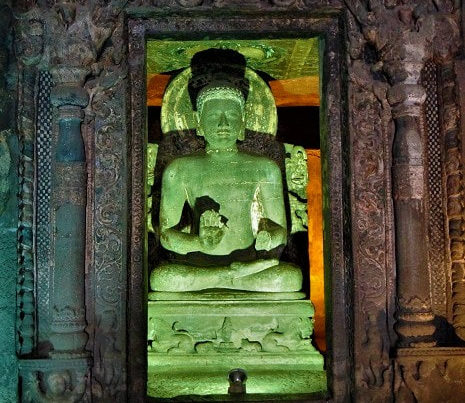
The Buddhist caves are among the earliest monuments at Ellora. These caves include monasteries, meditation spaces, prayer halls and sculptures associated with Buddhist traditions. Many of them were designed as viharas, which were residential and monastic spaces used by Buddhist monks. One of the most impressive examples is Cave 10, popularly known as the Vishvakarma Cave or Carpenter’s Cave. It is a chaitya hall featuring a large seated Buddha image and an impressive rock-cut vaulted ceiling. Its architectural design creates the appearance of a timber-built structure, demonstrating the sophisticated skills of ancient artisans.
Cave 11 and Cave 12 are also important Buddhist monuments, featuring multiple levels and elaborate architectural arrangements.
For visitors interested in Buddhism, ancient Indian monasteries and religious architecture, this group offers an excellent opportunity to understand how Buddhist communities lived and worshipped.
Hindu Caves (Caves 13–29)
The Hindu caves are among the most visually impressive monuments at Ellora. They feature sculptures and architectural elements associated with Shiva, Vishnu and other Hindu deities. The most famous monument in this group is Cave 16, the Kailasa Temple.
Other important caves include Cave 15, known as Dashavatara Cave; Cave 21, or Ramesvara; and Cave 29, also known as Dhumar Lena. These monuments contain elaborate sculptures, mythological narratives, pillars, courtyards and impressive religious imagery.
Visitors can discover scenes from Hindu mythology, representations of divine figures and artistic interpretations of important religious stories. The sculptures are not merely decorative. They communicate religious ideas, philosophical concepts and stories that were important to the communities that created these monuments.
Jain Caves (Caves 30–34)
The Jain caves represent another fascinating chapter in Ellora’s architectural history. They are particularly known for their intricate carvings, delicate decorative elements and representations of Jain Tirthankaras. Cave 32, popularly known as Indra Sabha, is one of the most remarkable monuments in this group. Despite its name, Indra Sabha is a Jain monument, not a Hindu temple. The Jain caves are particularly interesting for travellers who appreciate detailed sculpture, symbolism and religious architecture.
Many visitors spend less time exploring this section because they prioritise Kailasa Temple. However, if you have sufficient time, the Jain caves deserve attention.
Kailasa Temple: The Architectural Wonder of Ellora
No visit to Ellora is complete without exploring Kailasa Temple. Located in Cave 16, this magnificent structure is dedicated to Lord Shiva and is widely regarded as one of the greatest achievements of Indian rock-cut architecture. Unlike conventional temples, which are constructed by assembling stone blocks, Kailasa Temple was excavated directly from a single massive rock formation. The artisans carved the monument from the top down, removing the surrounding rock to reveal the temple structure. Imagine the level of planning, mathematical understanding, architectural knowledge and coordination required to accomplish such a project without modern machinery. The temple features a large courtyard, monumental entrance, sculpted pillars, galleries, shrines and numerous elaborate sculptures.
One of the most famous sculptural compositions depicts Ravana attempting to shake Mount Kailasa, the mythical abode of Lord Shiva. This dramatic scene demonstrates the exceptional artistic ability of the sculptors. The monument is also associated with the Rashtrakuta period, particularly the reign of Krishna I, although its development and artistic details reflect a wider history of patronage and craftsmanship.
Visitors should allow sufficient time to appreciate the scale of the temple rather than simply walking through the courtyard and taking photographs. Look closely at the elephants carved around the temple base, the narrative panels, the pillars and the details on the surrounding rock surfaces.
These elements reveal how much artistic effort went into creating this extraordinary monument.
How Much Time Do You Need to Visit Ellora Caves?
One of the most frequently asked questions by travellers is how many hours are required to explore Ellora. The answer depends on your interests, physical comfort and available time. There are 34 caves, and exploring every monument in detail can take considerably longer than most visitors expect.
Here is a practical recommendation:
For a 2–3-hour visit:
Concentrate on the major highlights, particularly Kailasa Temple, Cave 10 and selected important Hindu and Jain monuments.
For a 4–5-hour visit:
You can explore the major Buddhist, Hindu and Jain caves at a more comfortable pace, allowing time to appreciate the sculptures and architecture.
For a full-day visit:
You can spend additional time studying the details of the monuments, photography, architecture and historical background. If you are particularly interested in Indian history, religious traditions or ancient architecture, you may want to spend even longer. A knowledgeable guide can help you decide which caves deserve priority based on your available time.
Trying to see all 34 caves in a hurry is not necessarily the best way to experience Ellora.
Our recommendation
When we organise guided tours of Ellora, we spend five hours there. We don’t visit every cave, but we do see the most important ones. We enjoy helping you experience the spirit of the place and showing you its hidden details.
You’ll be able to discover the different facets of the various religions represented at the site. We’ll give you the keys to understanding the art and spirituality of the place.
What Are the Ellora Caves Timings and Entry Fees?
Before planning your visit, it is important to check the opening hours and entry charges.
According to the Archaeological Survey of India, Ellora Caves are generally open from sunrise to sunset and remain closed on Tuesdays.
The published entry charges are:
– Indian, SAARC and BIMSTEC visitors: ₹40 per person.
– Other foreign visitors: ₹600 per person.
– Children below 15 years: Free entry.
– Online ticket rates may be lower than the counter rates.
These charges should be reconfirmed on the official ASI website before travelling, as government rates and ticketing rules can change.
It is advisable to arrive early, especially during weekends, holidays and the winter tourist season.
Our advice
You can buy tickets online. This saves you time queuing to buy your ticket and allows you to get straight into exploring this exceptional site. By visiting the government website, you can buy your ticket quickly and easily.
What Is the Best Time to Visit Ellora Caves?
The best time to visit Ellora is generally between October and March, when temperatures are more comfortable for sightseeing.
Winter (October to February):
This is one of the most pleasant periods for exploring the caves. The weather is generally comfortable, making it easier to walk around the complex and spend several hours appreciating the monuments.
Summer (March to May):
Temperatures can become quite high in Maharashtra during summer. If you are visiting during this period, an early morning visit is preferable. Carry drinking water, wear comfortable footwear and take sufficient breaks.
Monsoon (June to September):
The surrounding landscape becomes greener and more attractive during the rainy season. The rocky hills and natural surroundings offer a different atmosphere.
However, visitors should be careful on wet surfaces and check local weather conditions before travelling.
Every season offers a different experience, but winter is generally the most comfortable choice for first-time visitors.
How to Reach Ellora Caves from Aurangabad?
Chhatrapati Sambhajinagar is the most convenient starting point for visiting Ellora. You can reach the city by air, train or road from several major Indian destinations. Once you arrive, there are different ways to reach the caves.
Private taxi:
Hiring a private taxi is one of the most convenient options, particularly for families, international visitors and senior citizens.
It allows you to travel at your own pace and combine Ellora with nearby attractions.
Public transport:
State transport buses and other local transport options connect the city with the Ellora region. These can be economical, although schedules and convenience may vary.
Can You Visit Ellora, Grishneshwar Temple and Daulatabad Fort in One Day?
Yes. These three attractions can be combined into a one-day sightseeing itinerary from Chhatrapati Sambhajinagar.
A typical itinerary could include:
1. Morning departure from Chhatrapati Sambhajinagar.
2. Visit to Daulatabad Fort.
3. Exploration of Ellora Caves.
4. Visit to Grishneshwar Jyotirlinga Temple.
5. Return to the city.
However, the sequence should depend on the opening hours, temple arrangements, weather and your interests. If you want to explore Ellora in depth, it is better to reduce the number of attractions rather than rushing through everything.
Daulatabad Fort itself deserves considerable time, particularly if you are interested in military architecture and medieval Deccan history.Grishneshwar is one of the twelve Jyotirlingas of Lord Shiva and attracts pilgrims throughout the year. Combining these destinations offers an interesting experience of architecture, religion and regional history.
Can You Visit Ajanta and Ellora Caves in One Day?
This is another common question among international tourists and visitors with limited holidays.
Our recommendation is to visit Ajanta and Ellora on separate days. Although both are UNESCO World Heritage Sites in Maharashtra, they are located in different directions from Chhatrapati Sambhajinagar and offer very different experiences. Ajanta is particularly famous for its ancient Buddhist caves, paintings, murals and sculptures. Ellora is known for its extensive rock-cut architecture representing Buddhist, Hindu and Jain traditions.
Both destinations require considerable travel time and several hours of exploration. Trying to visit both in one day means spending much of your time travelling and rushing through the monuments. A two-day Ajanta and Ellora itinerary is a much better option for anyone who wants to appreciate the history and architecture of these extraordinary places.
Why Should You Hire a Guide at Ellora Caves?
Ellora is a destination where having a knowledgeable guide can genuinely transform your experience.
At first glance, visitors may see beautifully carved pillars, sculptures, temples and large halls. However, understanding the historical and religious significance of these elements requires additional context.
Why is a particular deity represented in a certain form? What stories are depicted in the sculptures? Why were some caves designed as monasteries while others functioned as temples? How did ancient artisans create such elaborate structures from solid rock?
These are the questions that make a guided visit interesting. An authorised ASI guide can help explain the history, architecture, mythology and cultural significance of the monuments.
If you are visiting for the first time, particularly if you are an international traveller, we strongly recommend considering a guided experience.It is always advisable to confirm guide availability and language preferences before your visit.
Is Ellora Caves Suitable for Senior Citizens and Children?
Yes, Ellora can be visited by families, children and senior citizens. However, visitors should be aware that exploring the complex involves walking and some uneven surfaces.
The amount of walking depends on the caves you choose to visit. If you are travelling with elderly parents or people with limited mobility, plan a comfortable itinerary instead of attempting to explore every section.
Wear comfortable footwear, carry water and allow sufficient time for resting. Families travelling with children can make the visit more interesting by explaining the stories behind the sculptures and the engineering techniques used to create the monuments.
A guided tour can also help children understand the history in an engaging way.
What Should You Carry When Visiting Ellora?
A little preparation can make your visit more comfortable.
Here are some useful suggestions:
– Comfortable walking shoes or sandals.
– Drinking water.
– A hat or cap during warmer months.
– Sunscreen.
– A camera or smartphone for photography.
– Some cash for local purchases and incidental expenses.
– Any necessary personal medication.
Follow the monument’s photography rules and visitor instructions. Avoid touching, damaging or writing on the ancient sculptures and rock surfaces.
Remember that Ellora is not just a tourist attraction; it is a protected historical monument of international importance.
What Are the Other Places to Visit Near Ellora Caves?
If you have additional time in Chhatrapati Sambhajinagar, consider exploring some of the region’s other historical and cultural attractions.
Daulatabad Fort:
A magnificent medieval hill fort known for its strategic location, defensive architecture and fascinating history.
Grishneshwar Jyotirlinga Temple:
An important Hindu pilgrimage destination located close to Ellora.
Bibi Ka Maqbara:
A beautiful Mughal-era monument often compared with the Taj Mahal because of its architectural appearance.
Aurangabad Caves:
A lesser-known group of Buddhist rock-cut caves featuring impressive sculptures and historical details.
Panchakki:
A historical water-powered mill complex demonstrating the engineering knowledge of an earlier period.
Khuldabad:
A historic town with important religious and architectural monuments.
For travellers interested in heritage and culture, Chhatrapati Sambhajinagar offers enough attractions for a two- or three-day holiday.
Is Ellora Worth Visiting?
Absolutely.
Ellora is not simply a destination to visit because it appears on a UNESCO World Heritage list. It is a place that offers a deeper understanding of India’s artistic, religious and architectural history.
The coexistence of Buddhist, Hindu and Jain monuments, the extraordinary engineering of Kailasa Temple and the intricate craftsmanship throughout the complex make it a truly special destination.
Whether you are an architecture enthusiast, a history student, a photographer, a spiritual traveller or someone discovering India for the first time, Ellora offers something meaningful.The experience becomes even more rewarding when you have enough time to understand the stories behind the monuments.
Explore Ellora Caves with Akvin Tourism
At Akvin Tourism, we believe that travelling is not just about visiting places. It is about understanding their history, connecting with local culture and discovering stories that are often missed during ordinary sightseeing.
Based in Chhatrapati Sambhajinagar, we specialise in personalised heritage and cultural experiences across Maharashtra and other parts of India. We help Indian and international travellers plan their visits to Ellora Caves through customised itineraries, private transportation arrangements and guided sightseeing experiences.
Whether you are looking for an Ellora Caves private tour, an Ajanta and Ellora two-day tour, a local taxi or a customised Maharashtra heritage holiday, we can help you organise your journey according to your interests and available time.
We also understand that every traveller is different. Some visitors are passionate about architecture, others are interested in religion and history, while some simply want to experience India’s remarkable cultural heritage. Our approach is to make the journey comfortable, informative and meaningful. Visit Ellora not just to see the monuments, but to understand the stories carved into every stone.
You can contact us today to create an experience that suits you perfectly