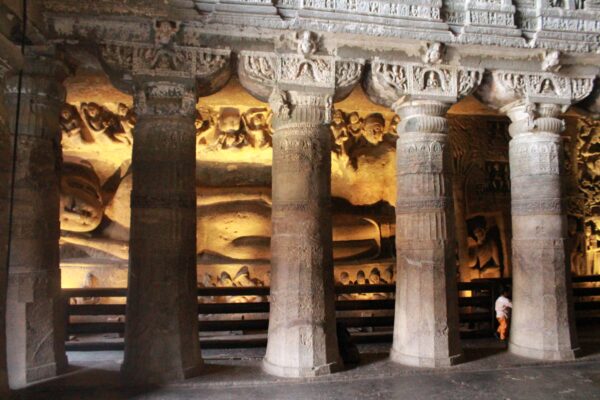
The Indian subcontinent is brimming with architectural treasures, but few sites can rival the mystery, beauty and historical significance of the Ajanta Caves. Listed as a UNESCO World Heritage Site since 1983, this Buddhist monastic complex, carved directly out of the rock, is an unmissable stop for any traveller exploring the state of Maharashtra. As destination specialists, we know that a trip to this ancient gem requires careful preparation. Whether you’re a history buff, an art lover or a traveller seeking spiritual fulfilment, Ajanta offers a transformative experience.
In this comprehensive and thoroughly researched guide, we reveal all its secrets so that you’ll be fully prepared to visit the Ajanta Caves.
What are the Ajanta Caves? A treasure trove of ancient art
Before planning the logistics of your trip, it is essential to understand the scale and significance of the site you are about to visit. Carved into the sheer face of a horseshoe-shaped gorge, overlooking the River Waghur, the Ajanta Caves comprise a complex of 30 Buddhist shrines and monasteries.
Two periods, two empires
Their construction spanned two distinct periods. The first phase, dominated by the Theravada (or Hinayana) school of Buddhism, dates back to the 2nd and 1st centuries BCE. The second phase, more prolific and lavish, developed under the Vakataka dynasty (around the 5th century CE), under the influence of Mahayana Buddhism. Unlike Ellora, which celebrates three major religions, Ajanta is a site exclusively dedicated to Buddhism.
Abandonment and rediscovery
The site was mysteriously abandoned in favour of Ellora and swallowed up by the dense jungle for centuries. It was not until 1819 that a British officer, John Smith, whilst on a tiger hunt, spotted the entrance to Cave 10 through the foliage, thereby restoring Ajanta to the modern world.
Unique paintings
The Ajanta Caves are world-famous for their remarkably well-preserved wall frescoes. These paintings, executed using the tempera technique (rather than fresco on wet plaster), depict the Jātakas (the Buddha’s previous lives), scenes from court life, and representations of deities, as well as fascinating details of the fashion, flora, and fauna of ancient India. The monumental sculptures, the intricately carved pillars and the immense figures of the Buddha carved from black basalt further cement this site’s status as an absolute masterpiece of rock art.
If you’d like to find out more about the differences between chaityas (prayer halls) and viharas (monasteries), as well as the detailed history of their iconic frescoes, we’ve put together a comprehensive article. Do feel free to have a look to help you plan your visit.
When to visit the Ajanta Caves: a comparison of the seasons
Maharashtra has a tropical climate characterised by significant seasonal variations. The time of year you choose to travel will greatly influence your experience at Ajanta. Here is a detailed comparison of the two seasons most favoured by travellers: the monsoon and the high season from September to March.
The magic of the monsoon (June–August)
Although the monsoon season in India is often avoided by traditional travellers, it offers a breathtaking natural spectacle for visitors to the Ajanta Caves.
- The landscape: the region, which is usually arid during the summer, is transformed into a vibrant green paradise. The horseshoe-shaped gorge is covered in lush vegetation.
- The river and waterfalls: This is the only time of year when the Waghur River is in flood. Furthermore, the famous seven-tiered waterfall (Sapta Kund), situated at the end of the gorge, roars majestically, recreating the very atmosphere that led the monks to choose this spot for their spiritual retreat.
- Crowds: There are generally fewer international tourists, although the site remains popular with Indian visitors at weekends.
- Drawbacks: The humidity is extremely high. The stone steps and footpaths can be very slippery. Sudden downpours mean you’ll frequently have to take shelter in the caves, and overcast skies can reduce the natural light inside the temples, making the paintings appear a little darker (the use of flash is strictly prohibited).
The ideal time to visit: September to March
This is the classic season and undoubtedly the most comfortable time to explore the site in optimal conditions.
- The post-monsoon season (September–October): This is undoubtedly the perfect balance. Nature is still lush and green, the waterfalls are still flowing a little, but the skies are clear and the rains stop.
- Winter (November–February): Temperatures are mild and pleasant, ranging from 12°C in the morning to 25°C in the afternoon. The air is dry, which makes exploring the site on foot (which involves a lot of walking and climbing stairs) much less strenuous.
- Lighting: The winter sun, lower in the sky, streams spectacularly into certain east-facing caves, naturally illuminating the interior shrines and the faces of the Buddhas—an astronomical and architectural phenomenon intentionally designed by the original builders.
- The downsides: It’s peak tourist season. The most famous caves (1, 2, 16, 17, and 26) can be crowded. It’s essential to start your visit very early in the morning to avoid the crowds and the midday heat.
Akvin Tourism’s verdict: If you’re a photographer who loves dramatic landscapes and aren’t bothered by humidity, the end of the monsoon season (August–September) is magical. For a cultural trip focused on comfort, a careful study of the murals, and optimal walking conditions, opt for winter (November through February).
Transportation Options: How to Get There?
The Ajanta Caves are located about 100 to 105 kilometres from Sambhajinagar (formerly Aurangabad), which serves as the essential base camp for the region, featuring an airport and good hotel facilities. The journey crosses the Deccan Plateau, offering views of cotton fields, rural villages, and rolling landscapes. Here’s how to cover this distance.
Private car with driver (the choice of excellence and comfort)
This is by far the option we recommend to ensure the success of your excursion.
- Comfort and safety: You’ll travel in a modern, well-maintained, air-conditioned vehicle. On India’s often unpredictable roads, an experienced professional driver ensures absolute safety.
- Flexibility: You set your own schedule. You can leave very early to arrive when the site opens, make photo stops along the way, or take a break at a clean, safe restaurant recommended by your driver.
- Efficiency: The direct trip takes about 2:00 to 2:30 hours. You’ll be dropped off directly at the official Ajanta parking lot (T-Junction) without any unnecessary detours.
Public or Tourist Bus (the budget option)
In Maharashtra, the MSRTC (Maharashtra State Road Transport Corporation) network operates regular buses from the Sambhajinagar Central Bus Terminal to the Ajanta junction (Fardapur).
- The experience: It’s a total immersion in local Indian life, but it requires patience and adaptability.
- Travel time: Expect a 3- to 4-hour drive, as the buses stop in many villages.
- Comfort: Standard public buses are not air-conditioned, the seats are basic, and the ride is often bumpy on rough roads. There are air-conditioned “Shivneri” buses or private tourist buses, which are more comfortable, but their schedules are less flexible. This is a viable option for travellers with plenty of time and a very tight budget but not recommended if you want to save your energy for visiting the site.
By Rickshaw/Tuk-Tuk (Strongly Not Recommended)
It’s sometimes tempting to negotiate a day-long auto-rickshaw ride, thinking you’ll have an authentic adventure. At Akvin Tourism, we strongly advise against this option.
- Distances: The rickshaw is designed for short urban distances, not for intercity trips of more than 100 kilometres.
- Time and discomfort: With a very limited top speed, the one-way trip can take more than 4 hours. The open cab exposes you directly to pollution, the intense dust from trucks on the highway, and the sweltering heat.
- Safety: Rickshaws offer no protection in the event of an accident on these roads frequented by heavy vehicles. Arriving exhausted and covered in dust before you’ve even begun your tour of this vast site will completely ruin your experience.
Sample Itinerary for a Successful Visit: Planning and Timing
To fully appreciate the Ajanta Caves, time management is essential. The most common mistake is underestimating the distance from Sambhajinagar and the sheer size of the site. Here is the ideal itinerary—based on our years of on-the-ground experience—for a stress-free day.
7:00 a.m. – Early morning departure from Sambhajinagar (Aurangabad)
To avoid the crowds and the afternoon heat, an early morning departure is essential. Make sure your hotel prepares a packed breakfast for you if the dining service does not
9:30 a.m. – Arrival at the Site: Entry Logistics
Access to the caves is strictly regulated for environmental preservation purposes. Private vehicles are not permitted to approach the site directly. There are two options for visiting the Ajanta Caves:
Option 1: The Standard Route via the Parking Lot (T-Junction) Your driver will drop you off at the visitor centre (Amenities Centre). From there, you’ll need to take a government-operated shuttle that will transport you the remaining 4 kilometres to the official entrance of the gorge. Allow about 30 minutes for this logistical transition (purchasing bus tickets, the ride, and purchasing the entrance ticket to the site).
Option 2: The Spectacular Approach via the Viewpoint This is our top pick for active travellers. Instead of dropping you off at the main parking lot, your driver will take a short detour to take you to the “Ajanta Viewpoint”, on the other side of the gorge. The panoramic view of the horseshoe-shaped gorge is breathtaking, especially in the morning. From this viewpoint, a steep path paved with hundreds of steps descends down the hillside, crosses the Waghur River via a bridge, and climbs directly back up to the base of Caves 8, 9, and 10. Please note: this option requires strong knees and appropriate hiking shoes. You’ll then meet your driver at the main parking lot at the end of the tour.
10:00 a.m. to 1:00 p.m. – Exploring the Caves
Set aside at least three to four hours to explore the site. Although there are 30 caves, not all of them warrant the same amount of attention. Since the caves are numbered 1 through 30 from east to west, the tour generally follows a linear route along the cliff.
- Under no circumstances should you miss Cave 1, famous for its priceless frescoes of the Bodhisattvas Padmapani (holding the lotus) and Vajrapani, masterpieces of world art.
- Cave 2 is renowned for its ceilings adorned with geometric and floral motifs of extraordinary precision.
- Caves 9 and 10 are magnificent ancient chaityas (prayer halls) with monumental stupas, among the oldest at the site.
- Cave 16 offers a breathtaking view of the river and houses the famous Hasti Jakata fresco.
- Conclude your tour with the imposing Cave 26, a magnificently carved chaitya housing the immense statue of the Reclining Buddha (Mahaparinirvana), depicting his passage into Nirvana.
Take the time to sit down, let your eyes adjust to the dim light, and observe the intricate details of the carvings and the serene expressions on the stone faces. The energy of the place is deeply soothing.
1:30 p.m. – Lunch and Return
After your visit, head back down the main path to catch the green shuttle back to the parking lot. The visitor center complex features restaurants operated by the MTDC (Maharashtra Tourism Development Corporation) offering decent vegetarian Indian cuisine. Other restaurants are available along the way. Feel free to ask your driver for recommendations. After lunch (around 2:30 p.m.), continue on your way. You’re typically scheduled to arrive at your hotel in Sambhajinagar around 5:30 p.m. The perfect time to unwind after this eventful day.
Additional practical information for visiting the Ajanta Caves
To ensure your experience is perfect, here are some essential recommendations from our team:
- Closed Days: The Ajanta Caves site is closed on MONDAYS. Be sure to plan your itinerary accordingly.
- Lighting and Photography: The caves are dimly lit to protect the millennia-old pigments in the frescoes. Tripods and the use of flash are strictly prohibited inside. Be sure to bring a camera with a high ISO range.
- Footwear: You’ll need to remove your shoes before entering most of the caves. We strongly recommend wearing shoes that are easy to take off (such as slip-ons) and bringing thick socks. The rocky ground can be scorching in direct sunlight or rough inside the caves.
- Monkeys: Macaques and langurs are very common on the site. Although they are part of the local charm, they are still wild animals. Do not feed them.
- Hydration: Bring enough water from the parking lot, as there are no places to buy bottled water once you’re on the cave trail (due to plastic waste management policies).
Why Choose Us for Your Trip to Central India?
Planning a trip to India—and especially to regions with such rich historical and cultural heritage—cannot be done on the fly. By placing your trust in us, you’re choosing much more than just a travel agency. You’re choosing a partner dedicated to ensuring your experience is exceptional.
Exclusive specialists in the region
Unlike generalist agencies, India – and central India in particular – is our core area of expertise. We put our local knowledge at your service to ensure an unforgettable trip.
Unrivalled quality of travel
We do not view our tours as mere races against the clock. Our itineraries are designed to give you time to marvelling at the sights. We guarantee you a journey with the very best drivers.
A commitment to sustainable tourism
We recognise the fragility of UNESCO-listed sites. We raise our travellers’ awareness of the need to respect both places and people, and we also undertake initiatives to support local development.
A genuine local commitment
We firmly believe that tourism should benefit the local communities. We work exclusively with local partners, thereby ensuring direct economic benefits for the communities of Maharashtra.
10 Years of Experience at Your Service
With a decade of on-the-ground experience, we have anticipated and resolved all the logistical challenges that India can present. From managing the unexpected to designing bespoke itineraries, our expertise ensures your peace of mind.
Unique Experiences
We can offer you homestays, visits to ancient temples, and much more… We want you to be a traveller, not just a tourist, when visiting the Ajanta Caves.
Let us transform your desire for discovery into an unforgettable human, cultural and spiritual adventure. Discover our tours dedicated to the region and let’s plan your trip together to the Ajanta Caves and beyond.