

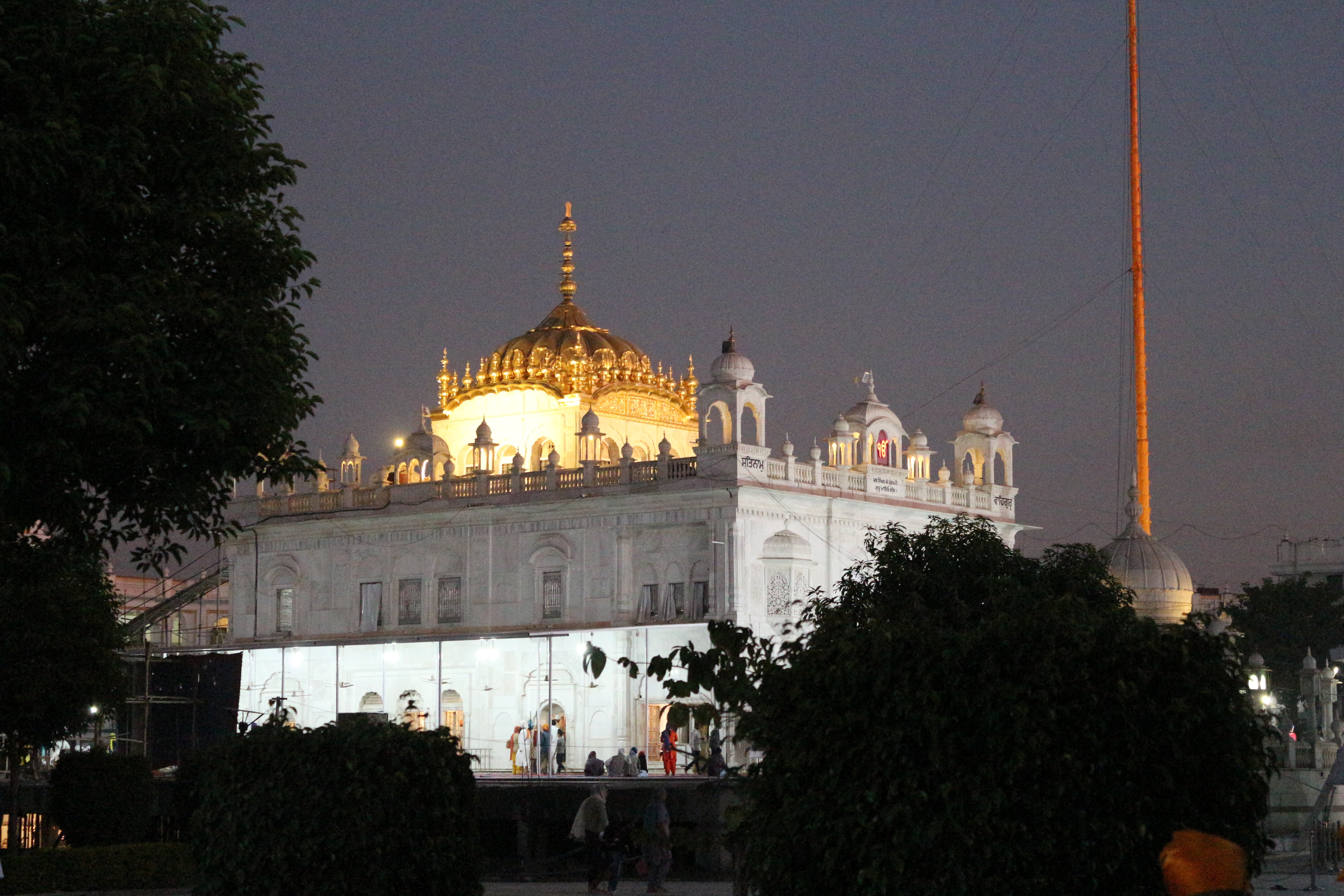
India is a land of abundant spirituality where every region and every city seems to vibrate to the rhythm of a thousand years of religious history. While Rajasthan is known for its palaces and Varanasi for its Hindu rituals, the state of Maharashtra is home to a destination of paramount importance for one of the world’s most dynamic religions: Nanded. Before delving into the historic streets of this holy city and discovering why it attracts millions of pilgrims, it is essential to understand the foundations of the faith that animates it. Sikhism, much more than a religion, is a philosophy of life, a moral code and a quest for truth that has shaped the history of the Indian subcontinent.
Understanding the Essence of Sikhism
Sikhism is a monotheistic religion that originated in the Punjab region of northern India at the end of the 15th century. Contrary to popular belief, it is not a mixture of Hinduism and Islam, but a distinct and original revelation. The term Sikh means disciple or student, emphasising that every believer is in a state of perpetual learning. The core of this faith is based on the belief in a single, formless, timeless and omnipresent God, often referred to as Waheguru (the Wonderful Lord).
This spirituality is distinguished by its categorical rejection of superstitions, meaningless rituals and, revolutionary for its time, the caste system. Sikhism advocates absolute equality between all human beings, regardless of their social origin, race or gender. This equality is manifested in the daily life of Sikhs, particularly through the practice of Langar (community canteen), where everyone sits on the floor at the same level to share a free meal, thus breaking down social barriers. The life of a Sikh is based on three fundamental pillars: meditation on the name of God, honest work to earn a living, and sharing the fruits of that labour with those in need.
The Lineage of Enlightenment: The Ten Gurus of Sikhism
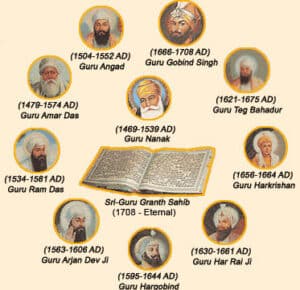
The history of Sikhism is inseparable from the lives of its ten spiritual masters, known as Gurus (those who dispel darkness). Over a period of more than two centuries, these ten figures successively nurtured, protected and structured the community, each leaving a unique legacy that today forms the foundation of the Sikh tradition.
Guru Nanak Dev: The Awakening of Consciousness
It all began with Guru Nanak Dev, born in 1469. From an early age, he showed an extraordinary spiritual disposition, questioning the established dogmas of his time. After a profound mystical experience in which he disappeared into a river for three days, he returned with a simple but powerful message: there are no Hindus or Muslims, only humanity united under one Creator. Guru Nanak spent most of his life travelling, walking thousands of kilometres to Mecca in the west, Tibet in the north and Sri Lanka in the south. His poetic hymns, which form a large part of the Sikh scriptures, call for sincerity of heart rather than religious ostentation.
Guru Angad Dev: The Transmission of Knowledge
Nanak’s successor, Guru Angad Dev, played a crucial role in perpetuating the teaching. Before becoming Guru, he was a devoted disciple named Lehna, whose humility and total obedience to Guru Nanak earned him the honour of being chosen. His major contribution was the standardisation of the Gurmukhi alphabet (from the mouth of the Guru), the script used to transcribe the Punjabi language. By formalising this script, he made the sacred hymns accessible to the people, breaking the monopoly of the priests who used complex Sanskrit. He also emphasised the importance of children’s education and encouraged physical fitness, establishing wrestling and sports centres for the community.
Guru Amar Das: The Social Reformer
Guru Amar Das attained the title of Guru at an advanced age, bringing with him wisdom and organisational skills. He is particularly revered for his bold social reforms. Guru Amar Das strongly opposed the practice of Sati (the immolation of widows on their husbands’ funeral pyres) and encouraged the remarriage of widows. He institutionalised Langar, insisting that anyone wishing to meet him, even Emperor Akbar, must first sit and eat with the people. He also divided the region into administrative dioceses to better manage the growing community, thus structuring the nascent Sikh faith into a true social organisation.
Guru Ram Das: Architect of the Holy City
The fourth guru, Guru Ram Das, is famous for founding the city of Ramdaspur, which later became Amritsar, the spiritual centre of Sikhism. He had the sacred pool, the Sarovar (nectar lake), dug, around which the Golden Temple would later be built. Guru Ram Das was the embodiment of humility and selfless service. He also composed the Lavan hymns, which are still recited today at every Sikh wedding ceremony, sealing the spiritual union of the couple. Under his guidance, the city became a prosperous commercial and spiritual centre, attracting artisans and devotees from far and wide.
Guru Arjan Dev: The First Martyr
Guru Arjan Dev, son of Guru Ram Das, was a prolific builder and scholar. He built the Harmandir Sahib (the Golden Temple) in the middle of the sacred pool, designing the temple with four doors open to the four cardinal points to symbolise its openness to all peoples. His major work remains the compilation of the Adi Granth, the first version of the holy book, bringing together the writings of previous Gurus as well as those of Hindu and Sufi saints. His growing popularity worried the Mughal emperor Jahangir. Refusing to alter the sacred scriptures or convert to Islam, Guru Arjan Dev was subjected to horrific torture and became the first Sikh martyr, forever changing the course of Sikh history towards more active resistance to tyranny.
Guru Hargobind: The Holy Soldier
Following his father’s martyrdom, Guru Hargobind introduced the martial dimension into Sikhism. He carried two swords: Miri, symbolising temporal authority, and Piri, symbolising spiritual authority. Guru Hargobind declared that in order to protect the faith and the oppressed, it was necessary to know how to wield weapons. He had the Akal Takht (the Throne of the Timeless) built opposite the Golden Temple, thus establishing a seat of justice and political governance. Although he was a formidable warrior who led several defensive battles, he remained a saint with a compassionate heart, transforming the Sikh community into a force of holy soldiers ready to defend justice.
Guru Har Rai: The Guardian of Compassion
The seventh Guru, Guru Har Rai, maintained the army of Sikh horsemen established by his grandfather but avoided direct conflict as much as possible. He was known for his gentleness and deep love for nature and animals. He established gardens of medicinal herbs and a free dispensary to care for the sick, regardless of their allegiance. It is even said that he cured the son of Emperor Shah Jahan, Dara Shikoh, with rare plants from his garden. His reign was a period of spiritual consolidation, emphasising compassion and medical service as forms of devotion.
Guru Har Krishan: The Wisdom of Childhood
Guru Har Krishan became Guru at the exceptionally young age of five. Despite his young age, he displayed a spiritual maturity that astonished the scholars of the time. His tenure was short but remarkable. During a smallpox epidemic in Delhi, the young Guru visited the sick, caring for them and comforting them without regard for his own safety. He eventually contracted the disease and died at the age of eight, sacrificing his life for others. He is remembered as the one whose mere sight dispelled all suffering, proving that divine wisdom does not depend on age.
Guru Tegh Bahadur: The Protector of Humanity
The ninth master, Guru Tegh Bahadur was a poet and a profound thinker. His legacy is marked by the ultimate sacrifice for freedom of conscience. When Hindu pandits (priests) from Kashmir came to beg him to protect them from the forced conversions imposed by Emperor Aurangzeb, Guru Tegh Bahadur decided to confront the emperor. He was arrested and publicly executed in Delhi for refusing to renounce his faith and for defending the right of Hindus to practise their own religion. His martyrdom is unique in history, as he gave his life not for his own community, but to protect the religious rights of another faith.
Guru Gobind Singh: The Creation of the Khalsa and the Connection to Nanded
The tenth and last human Guru, Guru Gobind Singh, was a warrior, poet and visionary philosopher. In 1699, he created the Khalsa (the order of the pure), a brotherhood of baptised Sikhs ready to give their lives for justice. He gave men the name Singh (Lion) and women the name Kaur (Princess), conferring upon them a sovereign identity. He formalised the physical symbols of faith, such as uncut hair. Before his death in Nanded, he declared that there would be no more human Gurus after him and that spiritual authority would henceforth reside in the holy book, the Guru Granth Sahib, considered to be the eternal and living Guru.
The Sacred Sites of Sikh Geography
In addition to its teachings, Sikhism is rooted in a sacred geography comprising five Takhats (thrones of temporal authority) and numerous historic gurdwaras. While the most famous is undoubtedly the Golden Temple in Amritsar, other sites are also of crucial importance.
The Akal Takht in Amritsar is the supreme seat of Sikh religious authority. It is here that decisions concerning the global community are made. Further east, in the foothills of the Himalayas, lies Anandpur Sahib, the city of bliss, where the Khalsa was founded. It is a place vibrant with martial energy, famous for its Hola Mohalla festival. In southern Punjab, Damdama Sahib marks the spot where Guru Gobind Singh completed the final version of the sacred scriptures after a period of intense warfare.
Outside Punjab, Patna Sahib, in the state of Bihar, commemorates the birthplace of Guru Gobind Singh. It is a major shrine for Sikhs in eastern India. These places are not mere monuments; they are active centres of community life where history is commemorated daily through prayer and service. However, there is a fifth throne, located far from the northern plains, in the heart of the Deccan Plateau, a place that marks the end of the tenth master’s earthly journey and is the focus of our attention today.
Nanded: The Ultimate Sanctuary on the Banks of the Godavari
Nanded is an ancient city located in the state of Maharashtra, bathed by the sacred waters of the Godavari River. To the uninitiated traveller, it may seem like a typical Indian city, but to the Sikh community, it is a holy land, imbued with a special emotion. It is here that Takhat Sachkhand Sri Hazur Sahib, one of the five thrones of Sikh authority, is located, and the place where Guru Gobind Singh Ji left his mortal coil to join the divine.
Nanded becomes a holy city
The history of Nanded as a Sikh pilgrimage site began in 1708. Guru Gobind Singh, after undergoing many trials and battles in the north, travelled to southern India to meet Emperor Aurangzeb, who was based in Aurangabad. Arriving on the banks of the Godavari River in Nanded, the Guru decided to set up camp there. It was here that he met Madho Das, a reclusive ascetic who, after attempting to test the Guru’s spiritual power, submitted and became his devotee under the name Banda Singh Bahadur. The Guru then sent him to Punjab to fight tyranny, marking a turning point in Sikh military history.
However, the Guru’s stay in Nanded was marked by a tragic event. While he was resting after evening prayers, two Pashtun assassins, sent by the governor of Sirhind (a sworn enemy of the Guru), infiltrated the camp and stabbed him. Although his wounds were initially treated by European surgeons, they reopened a few days later while the Guru was drawing a powerful bow. Realising that his time had come, Guru Gobind Singh gathered his community on 7 October 1708. In a final act of foresight, he did not appoint a human successor. He placed a coconut and five coins in front of the holy book, bowed, and declared the Guru Granth Sahib to be the eternal Guru of the Sikhs. He left this world shortly thereafter. The site of his cremation is now the inner sanctuary of the main temple, called Angitha Sahib.
Nanded: a temple created by the Lion of Punjab
The current complex of Gurdwara Hazur Sahib (meaning Presence of the Master) was built by the famous Maharaja Ranjit Singh, the Lion of Punjab, in the early 19th century. Unlike the gurdwaras in the north, which are mainly built of brick and lime, the architecture of Hazur Sahib reflects a distinct local and Mughal influence, with interiors lavishly decorated with gold leaf, stucco and precious stones. The atmosphere here is different from that of Amritsar; it is more solemn, steeped in history and the memory of the last human Guru.
The site also houses many priceless relics of Guru Gobind Singh, including weapons, swords, daggers and clothing, which are displayed to worshippers during specific ceremonies. The link between Nanded and Sikhism is indelible: it was here that the human lineage came to an end, giving way to the eternal sovereignty of Scripture. The city is dotted with other historic gurdwaras, each commemorating a specific event from the Guru’s stay, such as the Gurdwara Nagina Ghat or the Gurdwara Banda Ghat, creating a veritable pilgrimage circuit within the city itself.
Experience Nanded with Akvin Tourism
At Akvin Tourism, we understand that visiting Nanded is not just a tourist excursion, but a dive into a poignant history and vibrant culture. Our special Nanded tour is designed to offer you a complete and respectful immersion in this sacred world. We don’t just drop you off at the temples; we accompany you to decode the rituals, understand the meaning of the kirtan chants that resonate day and night, and appreciate the unique architecture of Hazur Sahib.
Our offer includes comfortable accommodation close to the holy sites, allowing you to attend dawn or evening prayers at your own pace. Our expert English-speaking guides will tell you fascinating details about the life of Guru Gobind Singh and take you to discover the outlying gurdwaras that are often overlooked by traditional tours. You will also have the unique opportunity to participate in Langar, sharing a communal meal to experience the values of equality and sharing in Sikhism. With Akvin Tourism, let yourself be transported by the spiritual fervour of Nanded and leave with a deeper understanding of the Indian soul.